As a fisheries and wildlife student part of my curriculum required me to take a botany class. I dreaded it. Sure, I had some 'houseplants' I kept in my cubicle at work and the importance of protecting forests. However, I never considered plants as anything other than the green stuff all us interesting, sentient animals roved around and utilized for survival. The entirety of the botany class involved focusing on features of plants to determine their identity by using a dichotomous key (see figure 1 for an example). A dichotomous key is a flowchart of chraceristics that is followed to ascertain the identity of the plant you are looking at.
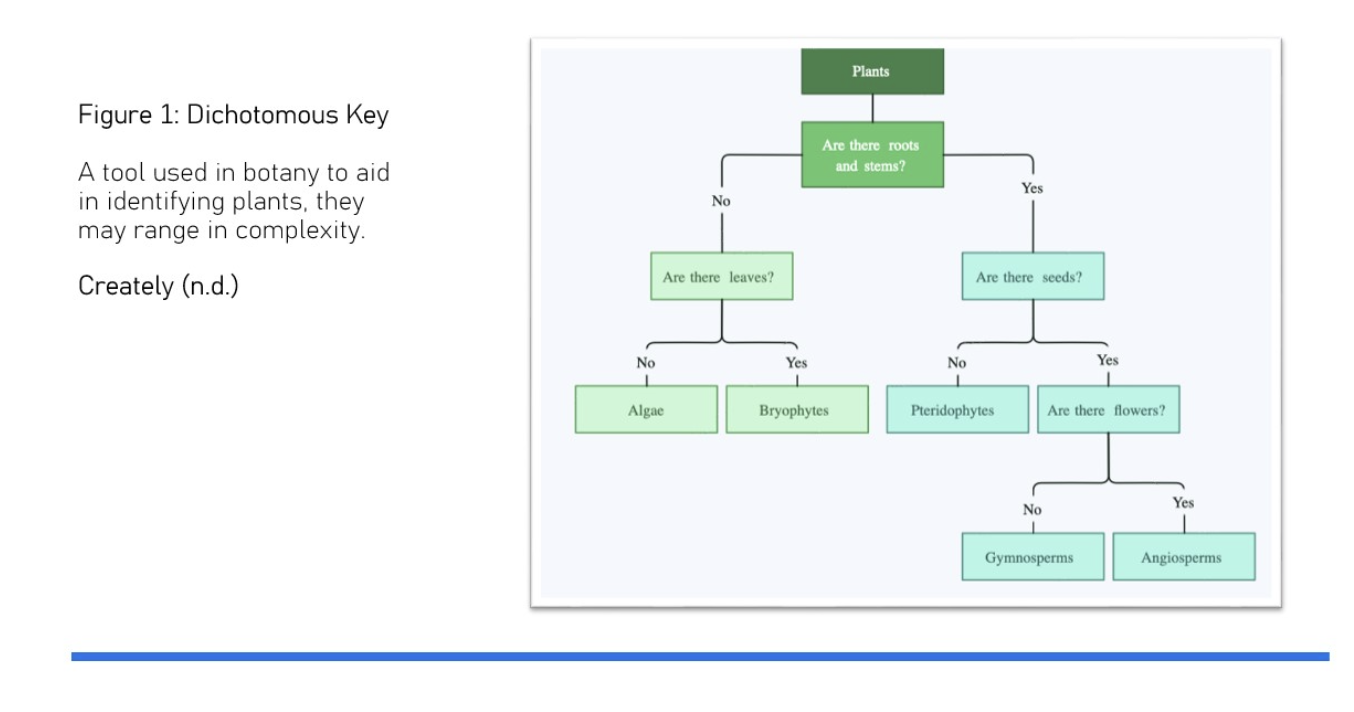
Learning how to differentiate plants from one another rocked my world. It reminded me of when I got my first pair of prescription eyeglasses when I was eight years old. I didn't know what I was missing until my surroundings came into focus. Everything felt so new. Similarly, instead of a flood of green, my eyes began to pluck out the features that made a plant unique. Having the language to describe what I saw not only made me feel more connected with my environment, but more appreciative of the beauty and diversity around me. I even sought out ways to learn more about plants!
Research has documented the positive influence nature has on human health and well-being. Heart rate, blood pressure, and respiratory rates - all objective measures of stress - are reduced when we spend time in green spaces (Gaekwad et al, 2023). Additionally, these benefits people recieve from spending time in nature spans cultures and appear fundamental to human health (Van den Born et al, 2025). Research has also shown that most people do not pay attention to plants in their everyday lives and in some cases, do not percieve plants as being alive at all (Parsley, 2020). This phenomena has been coined plant awareness disparity and contributes to negative outcomes in ecosystem health and by extension, human well-being (Gaekwad et al, 2023 & Parsley, 2020).
I certainly experienced this phenomena prior to taking a botany class. Learning a few key terms regarding leaf anatomy and morphology has been enough to instill a sense of wonder within me whenever I walk outside my door. I consider this one of the best gifts I have ever recieved and one I will now pass on to you, the reader.
The foundation of differentiating leaves is to understand what we are looking at when we see a leaf on a stem. This is called leaf morphology which is the study of leaf shape and structure (OSU, n.d.). Initially we are going to focus on only four things: the blade, the petiole, the stem, and the axillary bud (see figure 2). The blade is what most people view as the leaf of a plant and is typically flat and expanded (OSU, n.d). The petiole is the portion of the plant that connects the blade to the stem (keep in mind that some plants do not have this structure). The stem is the main body of the plant, and the axillary bud is the knobby structure that has the potential to grow into a fresh branch, flower, or shoot. It is found in the space between the leaf and the stem - against the petiole. This space is called the axil (OSU, n.d.).
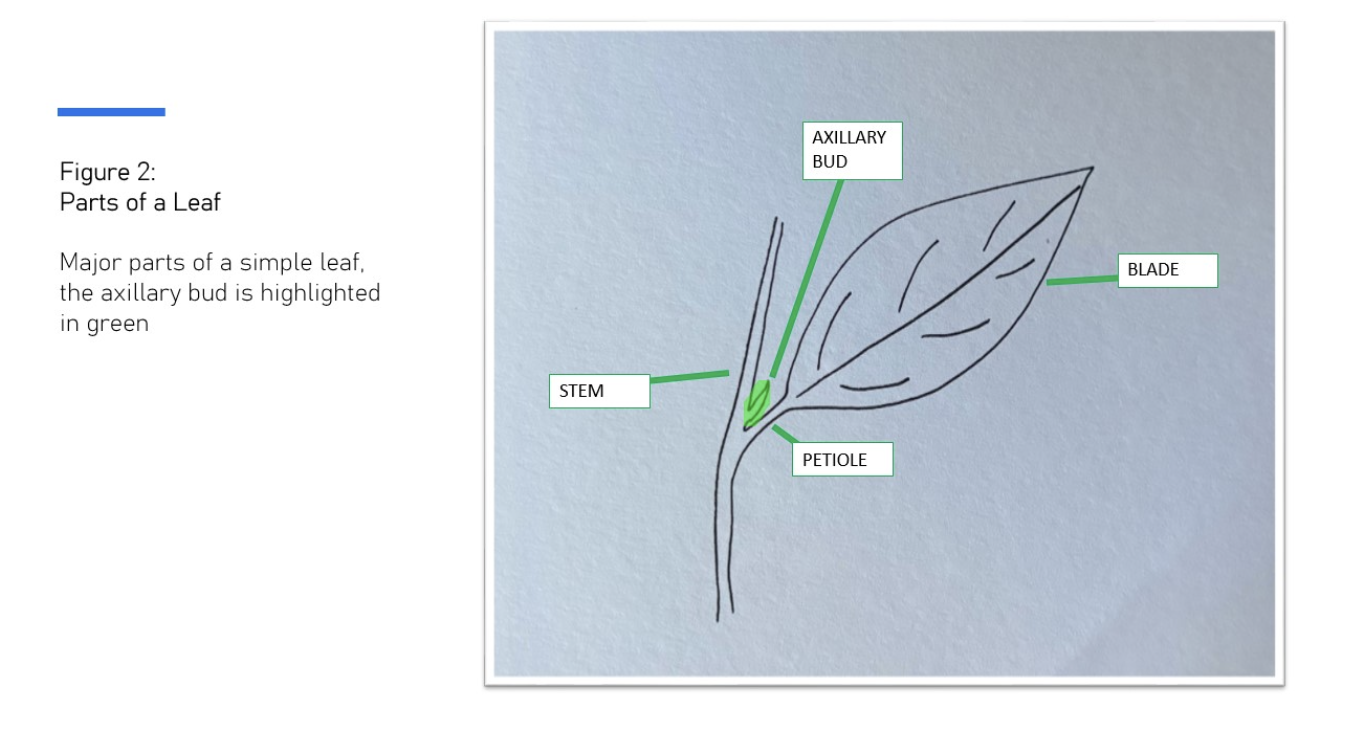
Now that we have the lay of the land we can move on to determining whether we are viewing a simple or a compound leaf. Simple leaves are single blades attached to the stem of a plant (an example can be seen in figure 2)(OSU, n.d.). Compound leaves are composed of many blades called leaflets that either attach to a stem-like structure called a rachis in pinnately compound leaves or grow from the same point of origin in palmately compound leaves. The rachis attaches to the main stem (OSU, n.d.). These structures can be seen in figure 3. The best way to tell a simple leaf from a compound leaf is to locate the axillary bud. If you are looking at a blade but don't see a bud it is most likely a leaflet. Continue investigating until you find that bud. If there are a collection of separate blades springing up near a single bud, you have a compound leaf. If you have a single blade, that's a simple leaf. Once you have practiced this for a bit we can take things a step further and start noticing the ways leaves are arranged on a stem.

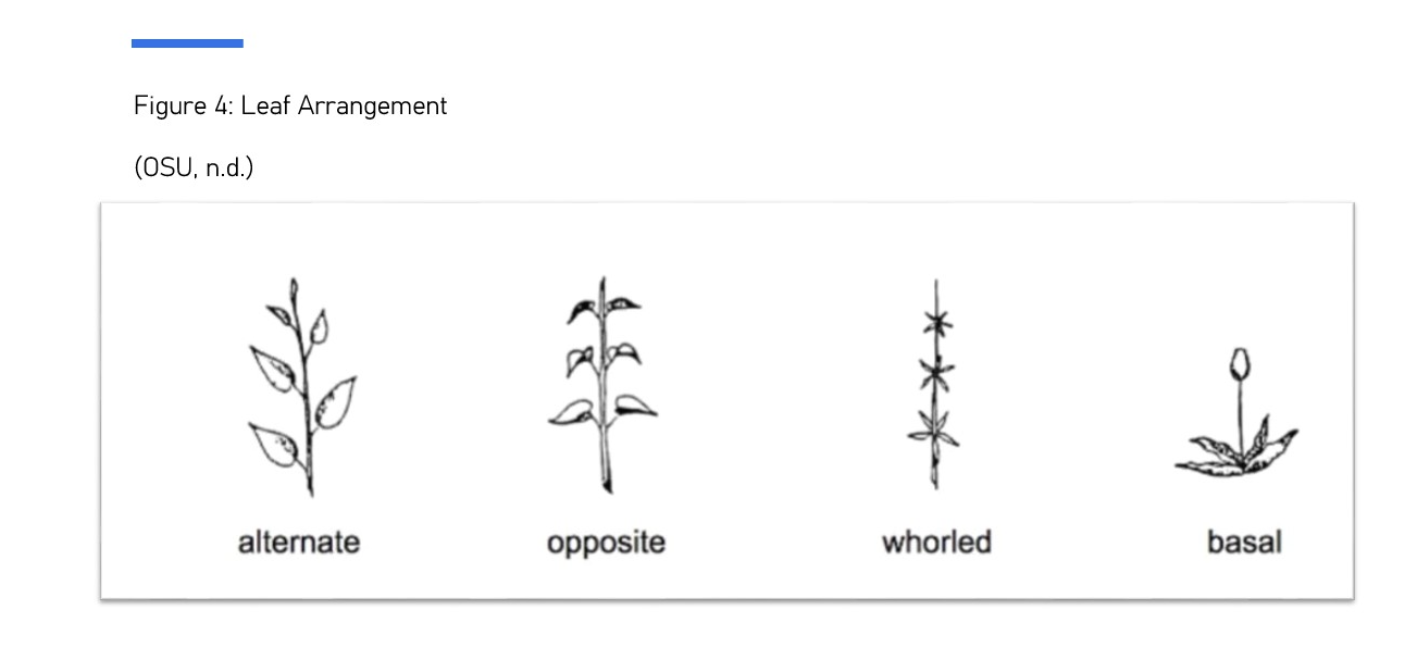
The four leaf arrangements are alternate, opposite, whorled, and basal. They can be seen in figure 4. Think of an alternate arrangement like a ladder. The leaves are just a little off center from each other and climb the stem as a person would a ladder. Opposite leaf arrangement shows leaves side by side in pairs along a stem (I think of them like dancers with clasped hands). Whorled leaves are clustered in groups of three or more along a stem and you will know basal leaves when you see them as the stem is bare and the origin of the leaves rest like a pile of clothes at the base of the plant.
Some advanced morphological characteristics you can look forward to learning about once you've mastered these basics is blade venation and what that looks like in simple versus compound leaves; leaf shape which categorizes the general outline or margin of leaves, the various names of shapes for leaf tips (apices), and more. When you think you have it all down, you'll discover all the modifications of leaves some plants have evolved to have in response to their environments and a variety of exceptions to the "rules" (OSU, n.d.).
In a world in which people are spending more time indoors and distanced from acitivities of historical importance such as gardening, harvesting, and foraging - being able to reconnect to the natural environment is of the utmost importance to individual and societal health. Learning leaf morphology and anatomy and using that knowledge is a simple way to either jumpstart or enhance a connection to nature in your everyday life.
References
Creately. (n.d). [image] Dichotomous Key for Plants. https://creately.com/diagram/example/CCzBCLmreuI/dichotomous-key-for-plants
Gaekwad, A.S.M. & Roos, P.B. (2023). A meta-analysis of physiological stress responses to natural environments: Biophilia and stress recovery theory perspectives. Journal of Environmental Psychology, 90(102085), ISSN 0272-4944.
Leaf and stem terminology. (n.d.). (pp 1-7). Oregon State University [OSU].
Oregon State University. (n.d.). [image] Leaf Arrangement. PDF
Parsley, K.M. (2020). Plant awareness disparity: A case for renaming plant blindness. Plants, People, Planet, 2, 598-601.
Van den Born, R.J.G., Moya-Mendez, N.C., de Groot, M., Duong, N.T.B., Gazevoort, W., van Heel, B.F., Hunka, A.D., Lenders, R.H.J., van Riper, C.J., Scopelliti, M., Verbrugge, L.N.H., & de Groot, W.T. (2025). Testing the biophilia hypothesis through the human and nature scale on four continents. Ecopsychology, 17(2), 119-130.
All uncredited images drawn/created by myself (Whit)
The bulk of this post is originally from an assignment I turned in for a botany class about leaf morphology in 2025- Revised for the purpose of this blog